
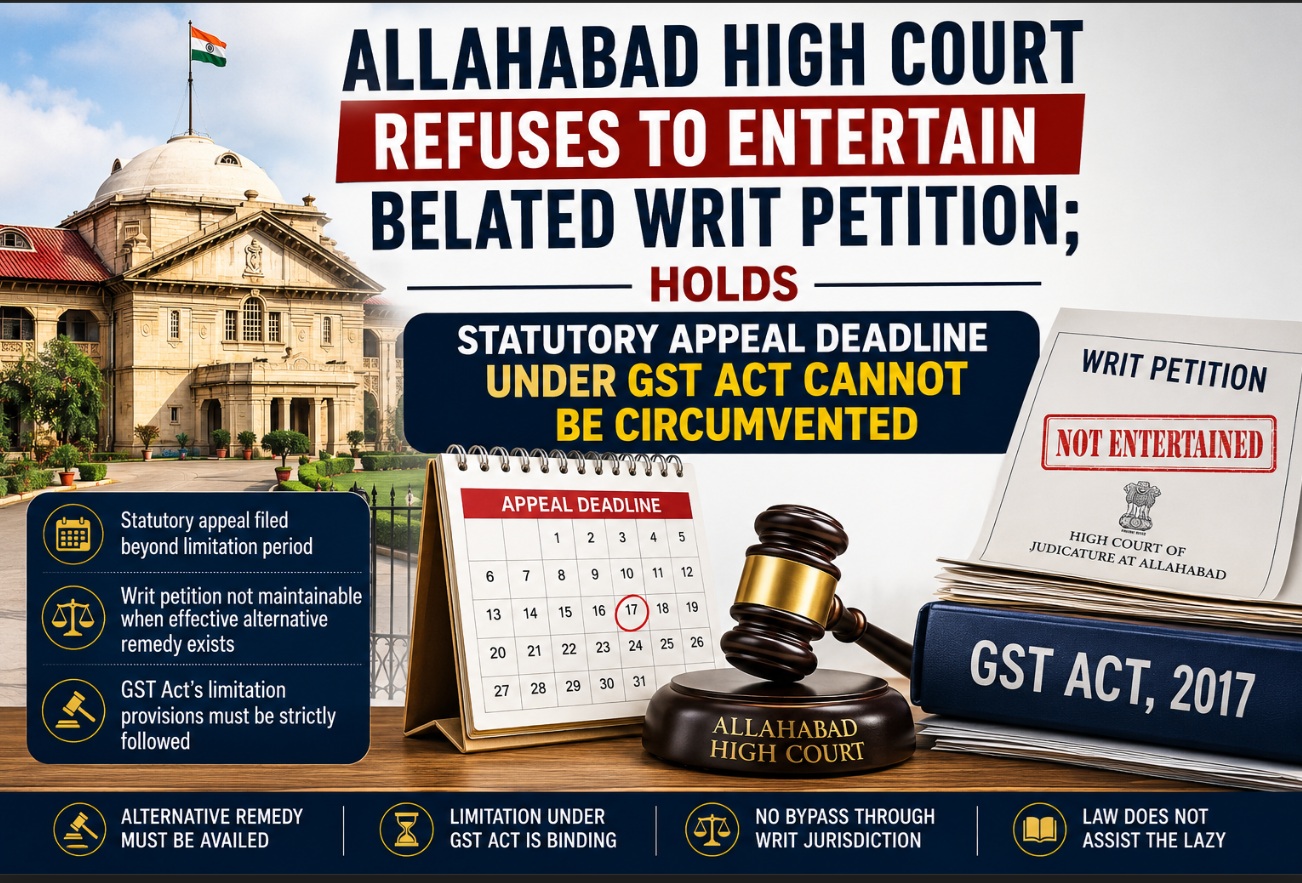
Allahabad High Court Refuses to Entertain Belated Writ Petition; Holds Statutory Appeal Deadline Under GST Act Cannot Be Circumvented
Share this article
PRAYAGRAJ, May 26, 2026 — In a judgment that reinforces the principle that writ jurisdiction cannot be used as a backdoor to bypass statutory limitation periods, the Allahabad High Court has dismissed a writ petition challenging an assessment order that was nearly a year old, holding that the petitioner’s failure to file a timely statutory appeal under the GST Act was fatal to his case.
A division bench of Justice Shekhar B. Saraf and Justice Abdhesh Kumar Chaudhary was hearing a petition filed by M/s Mishra Security Services, whose proprietor Smt. Sunita Mishra had sought to quash an assessment order dated June 4, 2025, and the preceding show-cause notice dated March 17, 2025.
The petitioner had earlier filed a writ petition in January 2026 — itself beyond the limitation period — which was dismissed as withdrawn with liberty to file afresh with better particulars. The present petition was the second attempt.
The court expressed its inability to countenance how the petitioner could file a writ petition at such a belated stage “merely to bypass the limitation prescribed for filing a statutory appeal under Section 107(1) of the GST Act.”
Section 107(1) provides for filing an appeal within three months from the date of communication of the order, with a further condonable period of one month under Section 107(4). The court noted that the outer limit had long since expired.
Relying on the Supreme Court’s authoritative pronouncements in Singh Enterprises vs. C.C.E., Jamshedpur (2008) and Commissioner of Customs and Central Excise vs. Hongo India Private Limited (2009), the bench held that the appellate authority under the GST Act has no power to condone delay beyond the statutorily prescribed period. The court also drew from the coordinate bench ruling in Atlantis Intelligence Ltd. vs. Union of India (2025), where Justice Saraf himself had distilled the principles governing maintainability of writ petitions after expiry of the statutory appeal period.
The Atlantis Intelligence ruling had established, among other things, that when a statute prescribes a maximum condonable delay (here, one additional month), Section 29(2) read with Section 3 of the Limitation Act applies, and courts have no power to condone any further delay — even in writ jurisdiction under Article 226 of the Constitution.
“We are rather surprised,” the bench observed, noting that the petitioner had been “a fence sitter” who had not been diligent in pursuing his rights. The court underscored the Latin maxim quando aliquid prohibetur ex directo, prohibetur et per obliquum — what cannot be done directly cannot be done indirectly.
The court, however, clarified that if the petitioner files an appeal, the observations made in the order shall not affect the decision of the appellate forum.
The judgment serves as a cautionary reminder to litigants that the extraordinary writ jurisdiction of the High Court is not a substitute for statutory remedies, and that courts will not readily assist those who sleep over their rights.
Share this article
Tags
Related Articles
Gauhati High Court Upholds Consolidated Show Cause Notices Under Sections 73 and 74 of the CGST Act: Tata Projects Limited v. Union of India
8 min read
Gauhati High Court Reaffirms: GST Registration Cancelled for Non-Filing Can Be Restored If Assessee Clears All Dues
6 min read

Gauhati High Court Quashes ₹69.57 Lakh GST Demand Against Silchar Scrap Dealer; Rules Buyer Cannot Be Penalised for Supplier’s Tax Default
5 min read